
Weitong Composite-Bleie mit modernster gewebter Roving-Technologie
In the field of composite materials manufacturing, closed-mold processes such as RTM (Resin Transfer Molding) and vacuum infusion impose stringent requirements on reinforcement materials—they must ensure rapid and uniform resin wet-out while guaranteeing consistent part thickness and reliable mechanical properties. Glass Fiber RTM Core Mat is specifically designed for these applications, and its core secret lies in its unique "sandwich" structure.
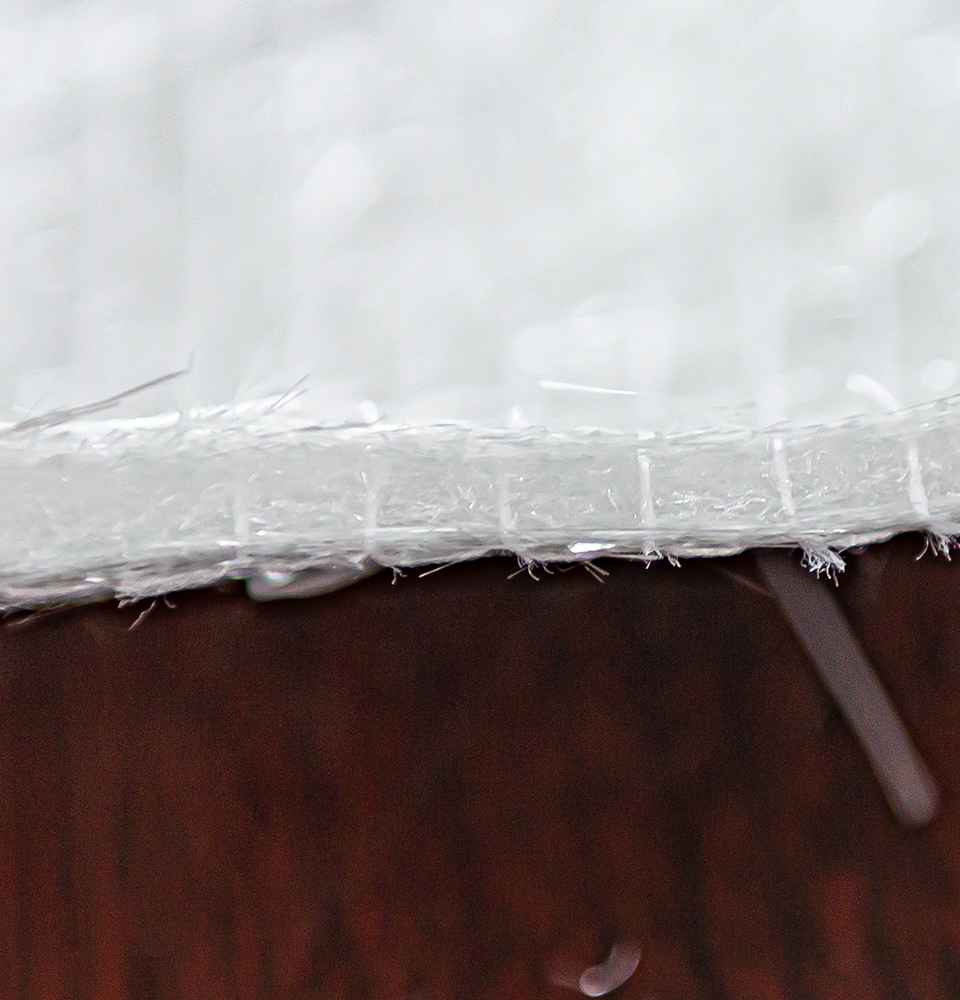
The "sandwich" structure of Glass Fiber RTM Core Mat typically consists of three layers. The materials and functions of each layer are as follows:
|
Structural Layer |
Material |
Core Function |
|
Top and bottom surface layers |
Glass fiber chopped strand mat (CSM) |
Reinforcement: Provides the foundational structural strength and stiffness. |
|
Middle core layer |
Synthetic non‑woven fabric (typically PP) |
Flow media and thickness control: Serves as a rapid flow channel to guide resin uniformly during infusion; also controls product thickness to ensure dimensional consistency. |
The three layers are combined through a stitching process and contain no chemical binders. This structure integrates reinforcement and flow-media functions into a single material, delivering mechanical performance while solving the challenge of rapid, uniform resin wet-out in RTM and other closed-mold processes.
One of the biggest challenges in closed‑mold processes is ensuring that the resin fully wets out all fibers before gelation.
The non‑woven core layer in Glass Fiber RTM Core Mat offers excellent resin flow characteristics, creating highly efficient resin distribution channels. Once resin is injected, the core layer guides it to spread rapidly in‑plane while simultaneously penetrating the upper and lower chopped‑strand layers, ensuring thorough fiber wet‑out and effective air evacuation.
For large or complex‑shaped molds, this advantage is particularly critical—it directly determines whether the final part will have dry spots, voids, or other defects.
Traditional fiberglass fabrics often suffer from inconsistent thickness during closed‑mold forming. The core layer of Glass Fiber RTM Core Mat acts as a "thickness gauge."
The upper and lower chopped‑strand layers are fixed at a specific distance by the core material, maintaining stable thickness control throughout the molding process and ensuring consistent part thickness after curing. This feature is essential for components with strict dimensional tolerance requirements.
"Reducing weight" and "maintaining strength" are often competing goals in composite materials. Glass Fiber RTM Core Mat cleverly balances this trade‑off through its "sandwich" structure.
The lightweight core material significantly reduces overall part weight without sacrificing strength. Meanwhile, the upper and lower CSM layers provide isotropic basic strength, while optional woven roving or multiaxial fabric layers offer directional reinforcement. Lightweight and structural strength are achieved simultaneously in one material.
Under the high‑temperature, high‑pressure conditions of closed‑mold forming, conventional reinforcement materials are prone to deformation, shrinkage, or displacement.
Glass Fiber RTM Core Mat, with its stitched construction that firmly bonds all layers together, maintains excellent dimensional stability under pressure and heat—without inter‑ply slippage or fiber misalignment.
RTM, vacuum infusion, and other closed‑mold processes differ fundamentally from traditional hand lay‑up:
1. Resin is injected into a closed mold, making it impossible to manually assist air evacuation and compaction as in hand lay‑up
2. Resin flow paths are determined by the preform; improper design can lead to "dry zones"
3. Once the mold is closed, the thickness of the reinforcement directly determines the final part thickness
The "sandwich" structure of Glass Fiber RTM Core Mat is engineered specifically to address these challenges. Unlike ordinary chopped strand mats that rely solely on resin flow for wet‑out, it actively guides resin through its core layer. Unlike conventional fabrics with uncontrolled thickness, it provides precise thickness control through its core. It turns the "uncontrollable" into the "controllable."
The "sandwich" structure of Glass Fiber RTM Core Mat is essentially a targeted optimization for the pain points of closed-mold processes: the flow core layer solves slow resin flow and uneven wet-out, while the upper and lower glass fiber layers ensure mechanical strength—achieving a balance of "molding efficiency, part performance, and ease of handling."
Although its unit material cost is slightly higher than that of ordinary chopped strand mats, its shorter cycle times, higher yield rates, and more consistent part performance make it more cost-effective in closed-mold applications. It is now one of the mainstream reinforcement materials in the closed-mold molding sector.